We use the functions
\begin{equation*}
\mathrm{studentid} \colon N \to I
\end{equation*}
and
\begin{equation*}
\mathrm{grade} \colon I \to G
\end{equation*}
To find the grade of a student, we first need to look up the student’s identification number in the table from
Figure 7.1.3 and then with the identification number look up the grade in the table from
Figure 7.1.3.
So to find Alice’s grade we first look up her identification number in
Figure 7.1.3 and find that it is
\(1001\text{.}\) From
Figure 7.1.5 we get that the grade of the student with identification number
\(1001\) is a
\(\mathsf{B}\text{.}\) Thus Alice’s grade in MAT 112 is a
\(\mathsf{B}\text{.}\)
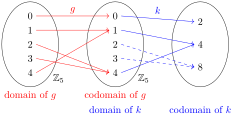
Now we formulate this process in terms of function composition The composite function
\begin{equation*}
\mathrm{grade} \circ\mathrm{studentid}
\end{equation*}
given a student’s name yields the student’s grade. The domain of \(\mathrm{grade} \circ\mathrm{studentid}\) is the set
\begin{equation*}
N=\{\mathsf{Aaron},\mathsf{Alice},\mathsf{Bob},\mathsf{Eve},\mathsf{James},\mathsf{Nathan},\mathsf{Oscar},\mathsf{Sandi}\}
\end{equation*}
of student names and the codomain of \(\mathrm{grade} \circ\mathrm{studentid}\) is the set
\begin{equation*}
G=\{\mathsf{A},\mathsf{B},\mathsf{C},\mathsf{D},\mathsf{F}\}
\end{equation*}
of grades. We get
\begin{align*}
(\mathsf{grade} \circ\mathrm{studentid} )(\mathsf{ Alice } )\amp=\mathrm{grade} (\mathsf{studentid} (\mathsf{ Alice } ))\\
\amp =\mathrm{grade} (1001)=\mathsf{B}\text{.}
\end{align*}