Skip to main content
Contents Index Dark Mode Prev Up Next \(\newcommand{\longdivision}[2]{#1\big)\!\!\overline{\;#2}}
\newcommand{\mlongdivision}[2]{\longdivision{#1}{#2}}
\renewcommand{\emptyset}{\{\}}
\newcommand{\blanksp}{\underline{\hspace{.25in}}}
\newcommand{\eridfive}{\mathbf{\forall}}
\newcommand{\set}[1]{\left\{#1\right\}}
\newcommand{\cspace}{-}
\newcommand{\Ta}{\mathtt{a}}
\newcommand{\Tb}{\mathtt{b}}
\newcommand{\Tc}{\mathtt{c}}
\newcommand{\Td}{\mathtt{d}}
\newcommand{\Te}{\mathtt{e}}
\newcommand{\Tf}{\mathtt{f}}
\newcommand{\Tg}{\mathtt{g}}
\newcommand{\Th}{\mathtt{h}}
\newcommand{\Ti}{\mathtt{i}}
\newcommand{\Tj}{\mathtt{j}}
\newcommand{\Tk}{\mathtt{k}}
\newcommand{\Tl}{\mathtt{l}}
\newcommand{\Tm}{\mathtt{m}}
\newcommand{\Tn}{\mathtt{n}}
\newcommand{\To}{\mathtt{o}}
\newcommand{\Tp}{\mathtt{p}}
\newcommand{\Tq}{\mathtt{q}}
\newcommand{\Tr}{\mathtt{r}}
\newcommand{\Ts}{\mathtt{s}}
\newcommand{\Tt}{\mathtt{t}}
\newcommand{\Tu}{\mathtt{u}}
\newcommand{\Tv}{\mathtt{v}}
\newcommand{\Tw}{\mathtt{w}}
\newcommand{\Tx}{\mathtt{x}}
\newcommand{\Ty}{\mathtt{y}}
\newcommand{\Tz}{\mathtt{z}}
\newcommand{\So}{\Tf}
\newcommand{\Sno}{\Tg}
\newcommand{\Si}{\Th}
\newcommand{\Sni}{\Tj}
\newcommand{\N}{\mathbb{N}}
\newcommand{\Z}{\mathbb{Z}}
\newcommand{\W}{\mathbb{W}}
\newcommand{\ZZ}{\Z}
\newcommand{\PP}{\mathbb{P}}
\newcommand{\Q}{\mathbb{Q}}
\newcommand{\R}{\mathbb{R}}
\newcommand{\RR}{\R}
\newcommand{\F}{\mathbb{F}}
\newcommand{\A}{\mathbb{A}}
\newcommand{\abs}[1]{|#1|}
\newcommand{\fmod}{\bmod}
\newcommand{\fdiv}{\,\mathrm{div}\,}
\newcommand{\lcm}{\mathrm{lcm}}
\newcommand{\id}{\mathrm{id}}
\newcommand{\nr}[1]{\##1}
\newcommand{\gexp}[3]{#1^{#2 #3}}
\newcommand{\gexpp}[3]{\displaystyle\left(#1\right)^{#2 #3}}
\newcommand{\glog}[3]{\log_{#1}^{#3}#2}
\newcommand{\sol}[1]{{\color{blue}\textit{#1}}}
\newcommand{\gro}[1]{{\color{gray}#1}}
\newcommand{\todo}[1]{{\color{purple}TO DO: #1}}
\newcommand{\fixme}[1]{{\color{red}FIX ME: #1}}
\newcommand{\checkme}[1]{{\color{green}CHECK ME: #1}}
\newcommand{\degre}{^\circ}
\newcommand{\vect}[1]{\overrightarrow{#1}}
\newcommand{\nix}{}
\newcommand{\cox}[1]{\fcolorbox[HTML]{000000}{#1}{\phantom{M}}}
\newcommand{\tox}[1]{\texttt{\##1} \amp \cox{#1}}
\newcommand{\ttx}[1]{\texttt{\##1}}
\newcommand{\mox}[1]{\mathtt{\##1}}
\newcommand{\xx}{\mathtt{\#}}
\newcommand{\lt}{<}
\newcommand{\gt}{>}
\newcommand{\amp}{&}
\definecolor{fillinmathshade}{gray}{0.9}
\newcommand{\fillinmath}[1]{\mathchoice{\colorbox{fillinmathshade}{$\displaystyle \phantom{\,#1\,}$}}{\colorbox{fillinmathshade}{$\textstyle \phantom{\,#1\,}$}}{\colorbox{fillinmathshade}{$\scriptstyle \phantom{\,#1\,}$}}{\colorbox{fillinmathshade}{$\scriptscriptstyle\phantom{\,#1\,}$}}}
\)
Section 1.1 Integers
In mathematics symbols are used to obtain a clearer and shorter presentation. The first of these symbols is the
ellipses (
\(\ldots\) ). When we use this symbol in mathematics, it means “continuing in this manner.” When a pattern is evident, we can use the ellipses (
\(\ldots\) ) to indicate that the pattern continues. We use this to define the integers.
The integers are the numbers
\begin{equation*}
\ldots,-7,-6,-5,-4,-3,-2,-1,0,1,2,3,4,5,6,7,\ldots
\end{equation*}
The positive integers are:
\begin{equation*}
1,2,3,4,5,6,7,\ldots
\end{equation*}
We also call the positive integers the natural numbers .
The negative integers are:
\begin{equation*}
\ldots,-7,-6,-5,-4,-3,-2,-1
\end{equation*}
The integer
\(0\) is not considered to be positive or negative.
In the video in
Figure 1.1.1 we give an introduction to the integers and statements.
Figure 1.1.1. The Integers (Part I: Definition and Statements) by Matt Farmer and Stephen Steward
Figure 1.1.2 shows the integers, natural numbers, and negative integers on the number line.
The number line with an ellipsis to the left and to the right and with the integers from -4 to 10 labeled
(a) The integers on the number line extend to the left and right.The number line with integers from
\(1\) to
\(10\) labeled followed by an ellipsis
(b) The natural numbers (or positive integers) on the number line extend only to the right starting at \(1\text{.}\) The number line with an ellipsis to the left and integers from
\(-4\) to
\(-1\) labeled
(c) The negative integers on the number line extend only to the left starting at \(-1\text{.}\)
Figure 1.1.2. Number lines
Subsection Comparing Integers
The symbols
\(=\text{,}\) \(\ne\text{,}\) \(\lt\text{,}\) \(\le\text{,}\) \(>\text{,}\) and
\(\ge\) are used to compare integers.
Table 1.1.3. Comparison symbols for integers
symbol
read as
\(=\) “is equal to”
\(\ne\) “is not equal to”
\(>\) “is greater than”
\(\ge\) “is greater than or equal to”
\(\lt\) “is less than”
\(\le\) “is less than or equal to”
The first symbol in
Table 1.1.3 is the equality symbol,
\(=\text{.}\) Two integers are equal if they are the same integer. To indicate that two integers are not equal we use the symbol,
\(\ne\text{.}\)
The other symbols compare the positions of two integers on the number line. An integer is greater than another integer if the first integer is to the right of the second integer on the number line. An integer is less than another integer if the first integer is to the left of the second integer on the number line.
Example 1.1.4 . Reading \(=\text{,}\) \(\ne\text{,}\) \(\gt\text{,}\) \(\ge\text{,}\) \(\lt\text{,}\) and \(\le\) .
We give examples of comparisons and how to read them.
\(2=2\) is read “2 is equal to 2.”
\(2\ne 3\) is read “
\(2\) is not equal to 3.”
\(3> 2\) is read “3 is greater than 2.”
\(3\ge 2\) is read “3 is greater than or equal to 2.”
\(2\lt 3\) is read “2 is less than 3.”
\(2\le 3\) is read “2 is less than or equal to 3.”
Subsection Operations
Addition, negation, subtraction, and multiplication are the basic operations of integers. We write “
\(+\) ” for plus, “
\(-\) ” for minus, and “
\(\cdot\) ” for times.
Example 1.1.5 . Statements involving integer operations.
We give some examples of statements that involve integer operations. As we do not say “is false” we mean that all of these equality statements are true.
\(2+3=5\) is read “2 plus 3 is equal to 5”
\(2+0=2\) is read “2 plus 0 is equal to 2”
\(2+(-2)=0\) is read “2 plus negative 2 is equal to 0”
\(2-2=0\) is read “2 minus 2 is equal to 0”
\(2\cdot 5=10\) is read “2 times 5 is equal to 10”
\(2\cdot(-5)=-10\) is read “2 times negative 5 is equal to negative 10”
\((-2)\cdot(-5)=10\) is read “negative 2 times negative 5 is equal to 10”
Multiplication of a natural number with an integer can be viewed as repeated addition.
Example 1.1.6 . Multiplication as repeated addition.
We give examples of multiplication viewed as repeated addition.
\(\displaystyle 3 \cdot 5 = 5+5+5=15\)
\(\displaystyle 3 \cdot (-5) = (-5)+(-5)+(-5)=-15\)
Again, we can use ellipses (\(\ldots\) ) to represent a continuing pattern:
\begin{equation*}
100 \cdot 5 =\underbrace{5+5+\ldots+5}_{100 \text{ copies of }5}=500\text{.}
\end{equation*}
Defining the multiplication of two negative integers is more involved, and we will not go into the reasoning here - just recall that the product of two negative integers is always positive.
Example 1.1.7 . Multiplication with negative integers.
We give examples of multiplication of integers and negative integers:
\(\displaystyle 3\cdot(-5) = -15\)
\(\displaystyle (-3)\cdot 5=-15\)
\(\displaystyle (-3)\cdot (-5)=15\)
Subsection Order of Operations
We use parentheses to indicate the order in which expressions should be executed. We evaluate the expressions in the innermost parentheses first and then work our way outwards.
Example 1.1.8 . Order of operations.
We give examples for order of operations. The numbers and the operations are the same; only the grouping of the expressions given by the parentheses differs.
\(\displaystyle (2+3)\cdot 4=5\cdot 4=20\)
\(\displaystyle 2+(3\cdot 4)=2+12=14\)
\(\displaystyle 5\cdot \left(2+(3\cdot 4)\right)=5\cdot(2+12)=5\cdot 14=70\)
\(\displaystyle (5\cdot 2)+(3\cdot 4)=10+12=22\)
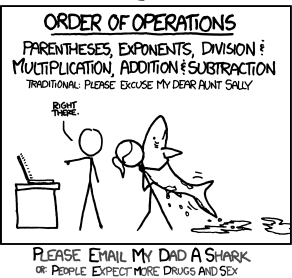
XKCD Presents: New Mnemonics
Order of Operations: Parentheses, Exponents, Division and Multiplication, Addition and Subtraction
Traditional Mnemonic: Please Excuse My Dear Aunt Sally
Person having a shark delivered to his laptop.
New Mnemonics: Please Email My Dad A Shark or People Expect More Drugs And Sex
Figure 1.1.9. From Mnemonics by Randall Munroe (https://xkcd.com/992
Example 1.1.10 . Associative property of addition.
We illustrate that the order of operations does not matter for expressions where the only operation is addition by computing the same sums in the order indicated by the parentheses. This phenomenon is called the associative property of addition
\(\displaystyle ((1+2)+3)+4=(3+3)+4=6+4=10\)
\(\displaystyle 1+((2+3)+4)=1+(5+4)=1+9=10\)
\(\displaystyle (1+2)+(3+4)=3+7=10\)
Usually we write
\(1+2+3+4=10\text{.}\)
In most cases, we will use parentheses to show the order of operations. Standard conventions also exist for the order of operations when parentheses are not used (see
Figure 1.1.9 ). One of these is that multiplication and division are performed before addition and subtraction. We follow these standard rules whenever too many parentheses would make an expression hard to read.
In the video in
Figure 1.1.11 we recap the operations for the integers and give a motivation for the following section.
Figure 1.1.11. The Integers (Part 2: Operations) by Matt Farmer and Stephen Steward