Definition 7.1.2.
Let \(A\) and \(B\) be nonempty sets.
-
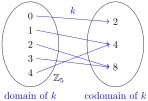
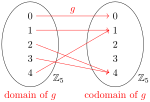
A function \(f\) from \(A\) to \(B\) assigns exactly one element of \(B\) to each element of \(A\text{.}\) We denote a function \(f\) from \(A\) to \(B\) by \(f \colon A \to B\) and we write \(f(a) = b\) if \(b\) is the unique element of \(B\) that is assigned to the element \(a \in A\) by \(f\text{.}\)
-
We read \(f:A\to B\) as “the function \(f\) from \(A\) to \(B\text{.}\)” We read \(f(a) = b\) as “\(f\) of \(a\) is \(b\)” or “\(f\) evaluated at \(a\) is \(b\text{.}\)”
-
The set \(A\) is called the domain of \(f\text{,}\) and the set \(B\) is called the codomain of \(f\text{.}\)
-
Suppose that \(f(a)=b\text{.}\) Then the element \(b\) is the image of the element \(a\) under the function \(f\text{,}\) and the element \(a\) is a preimage of the element \(b\) under the function \(f\text{.}\)